


Running Physio Melbourne: Elite Support for Every Mile
Running in Melbourne involves unique physical demands.
Whether you're training for the Melbourne Marathon, doing laps of the Tan, or navigating local trails, your body needs to withstand repetitive impact.
Should I see a Melbourne running physiotheapist with a special interest in running injuries?
Absolutely!

Generalists often don't cut it these days. You need to see experts who focus on this specific field.
Melbourne Sports Physiotherapy is a dedicated running clinic designed to keep runners moving. Our running physiotherapists combine clinical sports medicine with real-world experience to help you reach the pavement again. Plus, we'll help you with all your running injury rehabilitation and physiotherapy needs.
Melbourne's Running Landscape, Understood
From the crushed gravel of the Tan to the concrete of the Bay trail and the uneven fire trails of the Dandenongs, Melbourne runners load their bodies differently depending on where they train.
Our running physiotherapists factor in your specific training surfaces, not just your injury, when building your rehab and prevention plan.
What our clients think about us
Why See a Running Physiotherapist in Melbourne?
General physiotherapy is excellent for daily aches, but running sports medicine focuses specifically on the mechanics of your stride. You might wonder why your knee only hurts after the 5km mark or how to stop recurring shin splints from ruining your season.
We don't just tell you to stop running. Our goal is to find ways to keep you training safely. We use a systematic process to identify specific deficits. We then provide a targeted strengthening program for your calves, quads, hamstrings, glutes, and feet. While we may use soft tissue work to calm immediate pain, we focus on long-term strength to ensure you don't just mask the issue.
What to expect from our Comprehensive Running Assessment
We will ask you questions about your running level (elite/ sub -elite / amateur) and your running goals (sprints/ mid or long distance / marathons /recreation / fitness), so we have a clearly defined rehabilitation target tailored to you.
Next we will discuss your injury and recent running history. Please bring in any data you may have, ie Strava etc
Finally, we will complete physical testing, which may include a number of options, depending on each injury and situation.
Physical Testing of running injuries may include:
- Joint and muscle mobility and range of motion assessment
- Strength assessment using Hand Held Dynamometers
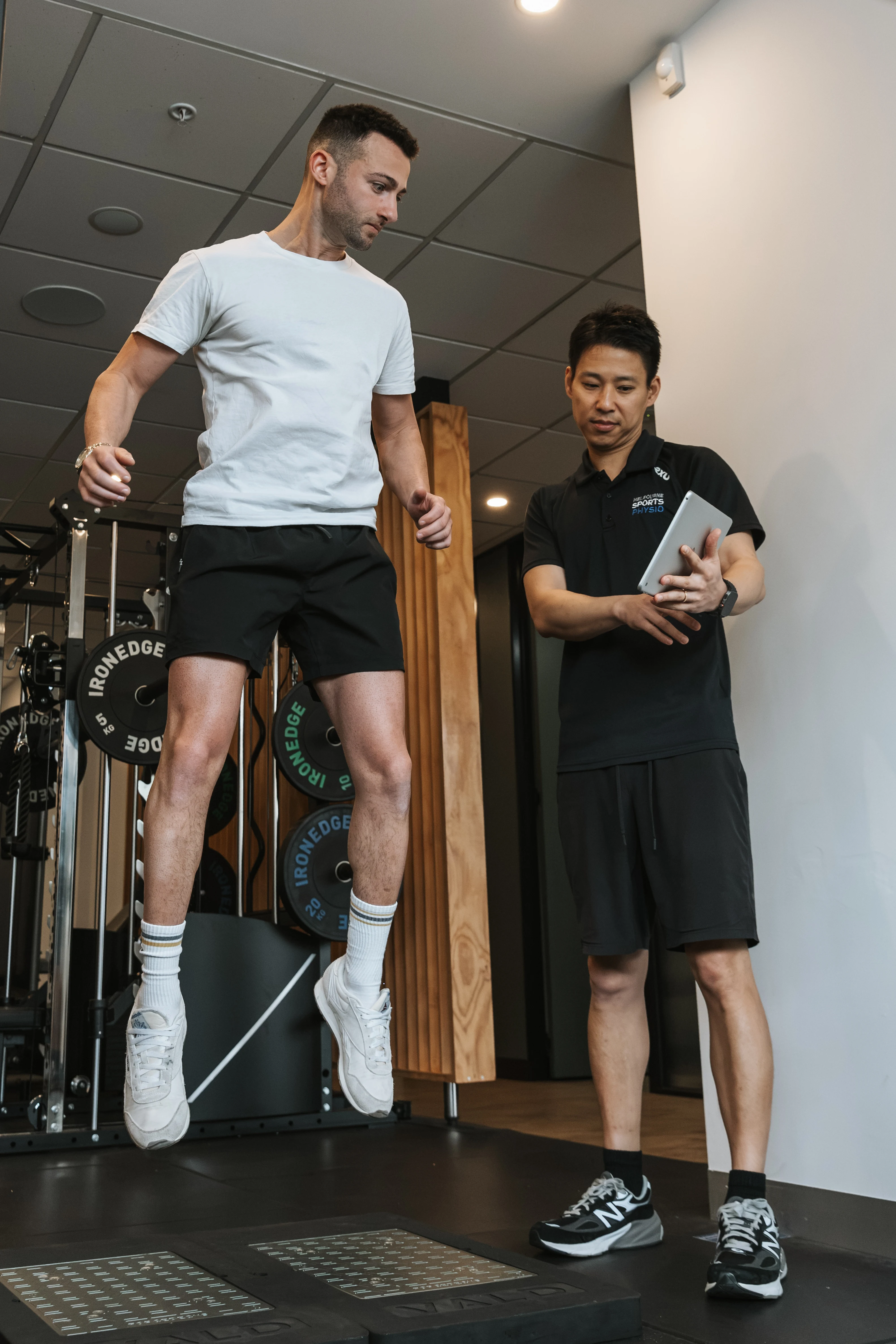
- Power & Rate of Force assessment using our high tech AxIT force plate system
- Treadmill assessment
- Training program and running load management assessment
- Sports Podiatry assessment and input (where required)
Having access to elite level testing equipment allows us to determine exactly what needs to change and improve to get you back running ASAP.
Understanding Your Running Injury
Plantar Fasciitis
A sharp, stabbing pain under the heel, usually worst with your first steps in the morning or after rest. It's caused by repeated strain on the band of tissue connecting your heel to your toes, often linked to a sudden increase in weekly running volume or unsupportive footwear.
Achilles Tendinopathy
A dull ache or stiffness at the back of the heel or lower calf, typically worse at the start of a run and easing once warmed up. This happens when the Achilles tendon is loaded faster than it can adapt, common in runners who've recently added hills or speed sessions.
Runner's Knee (Patellofemoral Pain Syndrome)
Pain around or behind the kneecap, often noticeable going downhill, downstairs, or after sitting for long periods. It's frequently linked to hip and glute weakness rather than the knee itself, which is why treatment focuses higher up the chain.
ITB (Iliotibial Band) Friction Syndrome
A sharp pain on the outside of the knee that tends to appear at a consistent distance into a run, then worsen. Poor hip control and lateral stability are usually the underlying cause, not the ITB itself.
Shin Splints (Medial Tibial Stress Syndrome)
An aching or burning pain along the inner shin bone, common in runners who've increased training load too quickly or changed running surfaces. Left unmanaged, this can progress toward a stress fracture.
Stress Fractures
A persistent, localised bone pain that worsens with activity and doesn't ease with rest. This requires structured, staged loading under professional guidance — running through it risks turning weeks of rehab into months.
Performance Coaching & Injury Prevention
You don't need to be injured to visit a running clinic. We offer strength and conditioning specifically for runners to help you absorb the energy of sudden physical stress.
Our team provides:
- Return to Run Programs: Scientific exercise progressions for those returning from long breaks or surgery.
- Holistic Care: We collaborate with podiatrists and strength coaches to ensure your footwear and training loads are optimized.
- Education: We guide you on dynamic stretching, hydration, and recovery times between sessions.
Why Running Injuries Happen
Most running injuries come down to one thing: load exceeding your body's current capacity to handle it. That's usually a mix of a few contributing factors — a rapid jump in weekly distance, inadequate strength in the hips, glutes or calves, worn-out or unsuitable footwear, or too little recovery between hard sessions.
A proper assessment identifies which of these apply to you, rather than guessing.
Book Your Running Physio Assessment In Melbourne Today
Common Melbourne Running Physiotherapy FAQS
How can a running physiotherapist in Melbourne help you get back running again?
It's simple really. Once we know exactly what is causing your running issues, we implement a plan to correct these deficits and get you back in action, comfortably.
We don't take short cuts, they don't work. (Trust us, we've tried everything over the years!)
What we do know that works is a systematic process, where we give you the correct rehabilitation program based on your specific deficits. No cookie cutter approach here.
In the vast majority of cases, you will have a targeted strengthening program, namely around the calf, quads, hamstrings, gluteals, trunk and foot intrinsic muscles.
Most people's gym programs cover a portion of these, though there are always more efficient and effective ways of training and strengthening. We will guide you through this.
It is likely we will do some soft tissue work in the short term to calm your pain down, though we know this isn't a permanent long term solution.
If you're coming to see our running sports physiotherapists in Melbourne just for a massage in the belief that this will solve your ongoing running issues, you are incorrect. It simply doesn't work, and if you're not willing to commit to a course of rehabilitative strength focused exercises, we suggest you seek treatment elsewhere.
How does a running physiotherapist know you're ready to run again, and do I need to stop running if I am injured?
Firstly, we'll do everything we can to keep you running if you are injured. This would likely be in a modified running program, though there are some injuries where total rest from running is required ( severe acute muscle tears, stress fractures for example).
We know the human body doesn't like rapid change to activity levels, so keeping you running whilst injured, even in a small capacity, can get you to your end goal faster without the need for a long re-load program.
We have specific testing and exercise progressions to ensure that your return to running is as scientific as possible.
This is very dependent on each individual's situation, though at a very simplistic level, if you can't hop comfortably, you're a long way from running.
How can you prevent further running injuries?
-
Keeping your muscles strong so they can absorb the energy of sudden physical stress.
-
Dynamic stretching of your before physical activity, i.e. calf rises or squats.
-
Gradually increasing the intensity and duration of you running training.
-
Practicing proper technique for running drills and other sporting activities.
-
Embracing a targeted running fitness programs to develop strength, balance, coordination and flexibility.
-
Gradually increasing the intensity and duration of you running training.
-
Allowing adequate recovery time between your runs and training sessions.
-
Wearing appropriate and correctly fitted footwear.
-
Drinking plenty of water before, during and after physical activity
How can physiotherapy treatment help running injuries?
If you're sick and tired of not running, or running with pain during, after or the next day, we can help you.
To make an appointment with our excellent running physios, you can make a time online below or call your nearest clinic on 1300 369 930.
If you have any questions about whether we're the right people to help you get back running, please contact us and one of our running physiotherapists will get back to you via phone.
We look forward to helping you return to running fast and comfortably soon!
BOOK ONLINE
How many physio sessions do I need for a running injury?
Most running injuries respond to a structured plan over 4–8 sessions, though this varies with injury severity and how long you've been managing symptoms before seeking help. Earlier assessment generally means a faster return to running.
Do I need new running shoes to fix my injury?
Sometimes, but not always. Footwear is one factor among several — training load, strength and running mechanics usually matter more. We'll tell you honestly if new shoes are actually the fix, or if it's something else.
Can I keep running while I see a physio?
In most cases, yes, in a modified form. We assess your specific injury to determine a safe training load rather than defaulting to full rest, which is rarely necessary or ideal for a runner's fitness and mental health.